I am here in Hammamet, Tunisia for the World Summit on the
Information Society. On many levels, it’s lovely to be here —
beautiful, temperate, a gathering of all manner of interesting,
public-spirited people from around the world who care about
information and communications technologies. Inside the enormous
function hall where the world’s telecomms/technology regulators have
gathered for the ITU’s Global Symposium for Regulators, I’m on a
terrific, open wi-fi network — sort of.
But the Net that I’m on
is not open. It is filtered, rather heavily. The method in
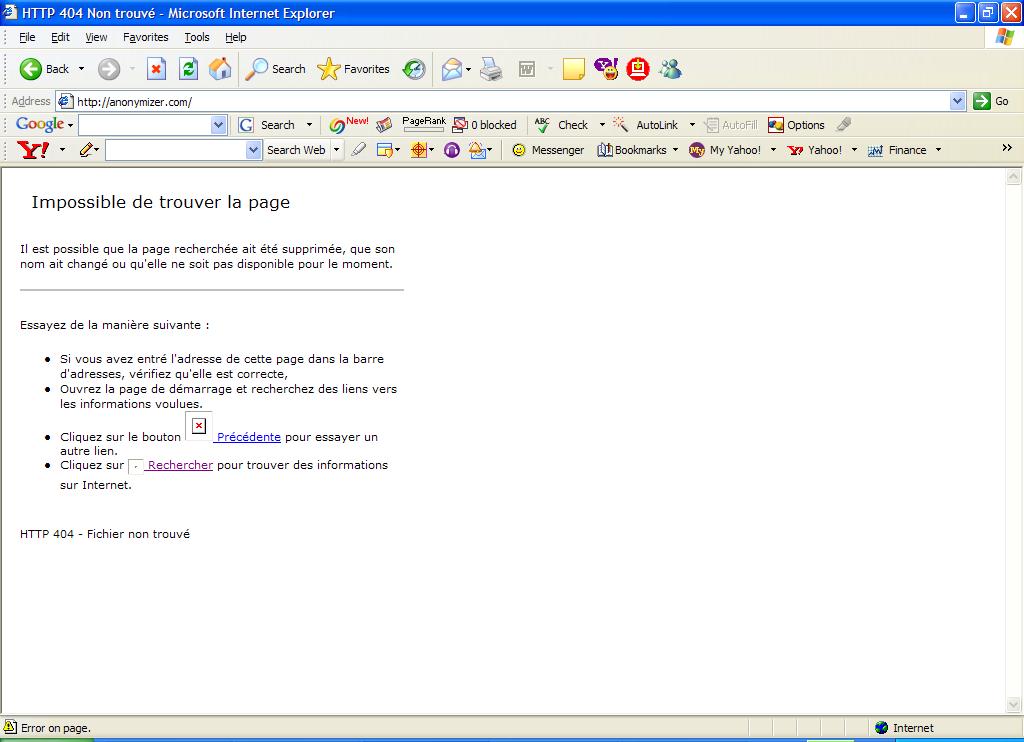
which it is being filtered is hardly transparent. Try accessing http://www.tunezine.com from wherever you are reading this. I can’t see that. Try http://anonymizer.com.
Nope, I can’t see that either. And what is accessible
is changing, as I type: yesterday, one could access http://www.citizens-summit.org/. Today, no dice. Also blocked: everything on this site: http://www.stupidcensorship.com/.
Instead, I get a block page, en francais, which misleadingly suggests that there’s a 404 error. If you want to see what I’m seeing, click here to
see the block page. That means, to most users, that the
page can’t be found — not that it was found and blocked by the state
for political (or other) reasons. Nart Villeneuve and the Citizen
Lab keep up a terrific gallery of block pages. You can get a sense there of the various options that those who filter have availed themselves of.
Our
hosts here are very gracious. It is very important for such a
substantial event to take place on the African continent. But the
topic of Tunisia’s filtering regime, and regimes like it, ought to be
on the agenda for WSIS, and it’s not. That’s one of the big
problems of this event — that important, but diplomatically tricky,
topics such as the balkanization of the Internet, in ways that often
mislead citizens and visitors alike, are left aside.
If I were in charge here, we’d start — not, NOT, with the future of ICANN — but rather here:
* * *
In dozens of nations around the world, the state takes part in
censoring what their citizens can see and do on the Internet.
This practice is increasingly widespread. Filtering regimes
are becoming more sophisticated and more commonplace around the world
as the Internet assumes greater importance as a means of communication,
as a forum for doing business, and as a hotbed of political
activism. There’s a cat-and-mouse game being played between
states that seek to control the information environment and citizens
who seek to speak and read and interact freely online.
The OpenNet Initiative — a joint research project of the University
of Cambridge, the University of Toronto, and Harvard Law School — has
found and documented extensive filtering regimes in place in China,
Iran, Burma (Myanmar), Uzbekistan, and, yes, Tunisia, among many other
countries (many reports and bulletins here).
Censorship using technological filters is often coupled with harsh laws
related to what the press can publish, opaque surveillance practices,
and severe penalties for people who break the state’s rules of using
the Internet.
At the same time as Internet censorship grows, heads of state and
their representatives are gathered here in Tunisia for a World Summit
on the Information Society. The widespread practice of blocking
citizens from accessing certain information on the Internet from within
a given state offers a point of engagement for the Internet governance
debate that takes place at this summit. The World Summit on
Information Society’s planners, the members of the United Nations ICT
Task Force, the members of the United Nations’ Working Group on
Internet Governance and others at the center of the Internet governance
debate should help to establish a set of principles and best practices
related to Internet filtering.
The Internet filtering problem, on one level, is an unattractive
candidate for the Internet governance decision-makers and others here
at WSIS to take up. Diplomatic niceties make hard conversations
about divisive issues unpleasant. A serious discussion of
Internet filtering would dredge up thorny topics like free expression,
privacy, national security, international enforcement, and state
sovereignty – issues on which states are likely to disagree
vehemently.
But in so doing, the Internet governance debate might
take on new life. It could focus discussion on the core problems
related to the divergence of views among states as to what a “good”
Internet looks like. It would put in relief the jurisdictional
issues related to every country in the world sharing a single, unitary,
public network of networks, far more powerful than any such network
that has come before, with the power to bring people together and to
divide them – while also acknowledging the fact that states can and do
exert power over what their citizens do on this network — much as
Jonathan Zittrain, Tim Wu, Jack Goldsmith, and others have
argued. It would prompt an examination of whether any single set
of rules might serve to address concerns related to content on the
Internet. And, in the process, it would encourage states to come
clean about the lengths they are willing to go to block their citizens
from accessing information online. At best, such a discussion
would bring the issue of state-based Internet censorship into the
spotlight and might, in the process, lead some states to reform their
Internet filtering practices so as to become more open and transparent.
The irony of Tunisia’s role in this summit, as both host and
as one of those states that filters the Net (and not just to keep
out pornography, but political speech, blogs, anonymizer services, and
other — to me — socially important speech), without a great deal of
transparency to citizens (or guests!) about what the state is doing,
brings this problem into sharp relief this week. That’s what we
should be talking about in terms of Internet governance, though it’s
unlikely to take place, except here in the blogosphere.
Look to the ONI for more on this topic, very soon. As always, Ethan Zuckerman is an amazing resource. Also, the AP is running a story on this general topic.
(Drawn in part from “Local Nets: Filtering and the Internet
Governance Problem,” John G. Palfrey, Jr., (chapter in Jack Balkin et
al., The Global Flow of Information, forthcoming 2006). For the
full paper, please click here.)
 John Palfrey