On being filtered in Tunisia, or, What WSIS Should Really Focus On

I am here in Hammamet, Tunisia for the World Summit on the
Information Society.  On many levels, it’s lovely to be here —
beautiful, temperate, a gathering of all manner of interesting,
public-spirited people from around the world who care about
information and communications technologies.  Inside the enormous
function hall where the world’s telecomms/technology regulators have
gathered for the ITU’s Global Symposium for Regulators, I’m on a
terrific, open wi-fi network — sort of.

But the Net that I’m on
is not open.  It is filtered, rather heavily.  The method in
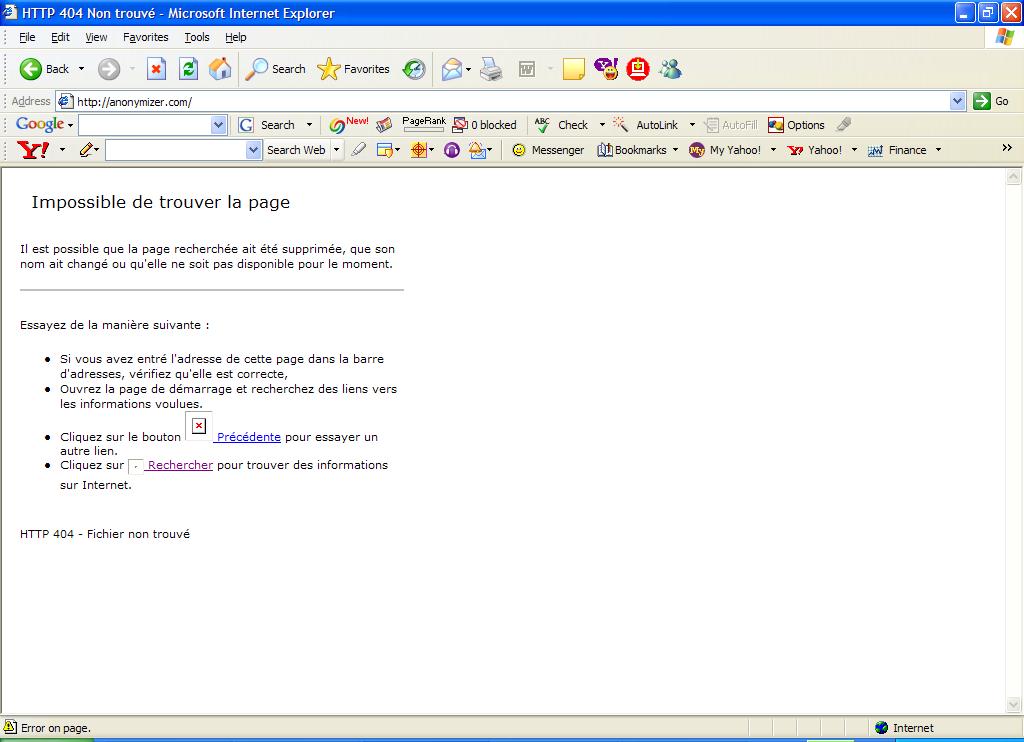
which it is being filtered is hardly transparent.  Try accessing http://www.tunezine.com from wherever you are reading this.  I can’t see that.  Try http://anonymizer.com
Nope, I can’t see that either.   And what is accessible
is changing, as I type: yesterday, one could access http://www.citizens-summit.org/.  Today, no dice.  Also blocked: everything on this site: http://www.stupidcensorship.com/.

Instead, I get a block page, en francais, which misleadingly suggests that there’s a 404 error.  If you want to see what I’m seeing, click here to
see the block page.  That means, to most users, that the
page can’t be found — not that it was found and blocked by the state
for political (or other) reasons.  Nart Villeneuve and the Citizen
Lab keep up a terrific gallery of block pages.  You can get a sense there of the various options that those who filter have availed themselves of.

Our
hosts here are very gracious.  It is very important for such a
substantial event to take place on the African continent.  But the
topic of Tunisia’s filtering regime, and regimes like it, ought to be
on the agenda for WSIS, and it’s not.  That’s one of the big
problems of this event — that important, but diplomatically tricky,
topics such as the balkanization of the Internet, in ways that often
mislead citizens and visitors alike, are left aside.  

If I were in charge here, we’d start — not, NOT, with the future of ICANN — but rather here:

* * *

In dozens of nations around the world, the state takes part in
censoring what their citizens can see and do on the Internet. 
This practice is increasingly widespread.  Filtering regimes
are becoming more sophisticated and more commonplace around the world
as the Internet assumes greater importance as a means of communication,
as a forum for doing business, and as a hotbed of political
activism.  There’s a cat-and-mouse game being played between
states that seek to control the information environment and citizens
who seek to speak and read and interact freely online.

The OpenNet Initiative — a joint research project of the University
of Cambridge, the University of Toronto, and Harvard Law School — has
found and documented extensive filtering regimes in place in China,
Iran, Burma (Myanmar), Uzbekistan, and, yes, Tunisia, among many other
countries (many reports and bulletins here).  
Censorship using technological filters is often coupled with harsh laws
related to what the press can publish, opaque surveillance practices,
and severe penalties for people who break the state’s rules of using
the Internet. 

At the same time as Internet censorship grows, heads of state and
their representatives are gathered here in Tunisia for a World Summit
on the Information Society.  The widespread practice of blocking
citizens from accessing certain information on the Internet from within
a given state offers a point of engagement for the Internet governance
debate that takes place at this summit.  The World Summit on
Information Society’s planners, the members of the United Nations ICT
Task Force, the members of the United Nations’ Working Group on
Internet Governance and others at the center of the Internet governance
debate should help to establish a set of principles and best practices
related to Internet filtering. 

The Internet filtering problem, on one level, is an unattractive
candidate for the Internet governance decision-makers and others here
at WSIS to take up.  Diplomatic niceties make hard conversations
about divisive issues unpleasant.  A serious discussion of
Internet filtering would dredge up thorny topics like free expression,
privacy, national security, international enforcement, and state
sovereignty – issues on which states are likely to disagree
vehemently. 

But in so doing, the Internet governance debate might
take on new life.  It could focus discussion on the core problems
related to the divergence of views among states as to what a “good”
Internet looks like.  It would put in relief the jurisdictional
issues related to every country in the world sharing a single, unitary,
public network of networks, far more powerful than any such network
that has come before, with the power to bring people together and to
divide them – while also acknowledging the fact that states can and do
exert power over what their citizens do on this network — much as
Jonathan Zittrain, Tim Wu, Jack Goldsmith, and others have
argued.  It would prompt an examination of whether any single set
of rules might serve to address concerns related to content on the
Internet.  And, in the process, it would encourage states to come
clean about the lengths they are willing to go to block their citizens
from accessing information online.  At best, such a discussion
would bring the issue of state-based Internet censorship into the
spotlight and might, in the process, lead some states to reform their
Internet filtering practices so as to become more open and transparent.

The irony of Tunisia’s role in this summit, as both host and
as one of those states that filters the Net (and not just to keep
out pornography, but political speech, blogs, anonymizer services, and
other — to me — socially important speech), without a great deal of
transparency to citizens (or guests!) about what the state is doing,
brings this problem into sharp relief this week.  That’s what we
should be talking about in terms of Internet governance, though it’s
unlikely to take place, except here in the blogosphere. 

Look to the ONI for more on this topic, very soon.  As always, Ethan Zuckerman is an amazing resource.  Also, the AP is running a story on this general topic.

(Drawn in part from “Local Nets: Filtering and the Internet
Governance Problem,” John G. Palfrey, Jr., (chapter in Jack Balkin et
al., The Global Flow of Information, forthcoming 2006).  For the
full paper, please click here.)

Voting in Somerville tomorrow

Ward 6 of Somerville, Massachusetts, has been a hot-bed of political activism this Fall. Election day tomorrow involves tough choices. I thought I’d vote out loud, or at least weigh the options out loud.

* A young, progressive woman, Rebekah Gewirtz, with a background in community activism, is challenging 22-year incumbent Jack Connolly for Ward 6 Alderman. Ms. Gewirtz has visited our street more than a dozen times, easily, leaving fliers and ringing everyone’s bell — working incredibly hard. Mr. Connolly has not come by once (at least that I’ve noticed), but he’s sent a great deal of mail to make the case for his candidacy. Gewirtz and Connolly have gone “comparative,” with almost-negative statements about one another (OK, some people would definitely call it negative) in the mail that hits every few days from each of them. Signs in the ward seem about evenly split. Mr. Connolly has served the neighborhood for a very long time, has a local business, and local endorsements, so will be hard to unseat. I give Ms. Gewirtz a great deal of credit for the race she has run — energetic, serious, and tough. No matter what, her candidacy has stirred up a number of issues and has made a long-time incumbent take re-election seriously. (Here’s what Ms. Gewirtz said in response to the Somerville Dog Owners’ Group‘s questionnaire, in case you were wondering. Isn’t the Internet great?)

* For School Committee in Ward 6, there’s a man named Paul Bockelman who has come by our house, running against Jim Thomas, whom I have not met. They are after a seat that the previous incumbent has relinquished. I am voting for Mr. Bockelman, since one of our neighbors brought him by our home, he seemed smart and capable, and his qualifications — as a long-time town manager — seem excellent. In addition to our neighbor, many of the local publications and officials have backed Mr. Bockelman. (I haven’t been able to learn much about his challenger, Mr. Thomas, beyond what his website says.)

* For Alderman-at-Large, we vote for four of the seven candidates (straight-up, not proportional representation, like Cambridge). I’ve heard in particular from Marty Martinez, a challenger with a celebrated background in youth services, and a young attorney, Kim Foster-Hirsch, who has lived in Somerville her whole life and has been articulate in what I’ve read and seen about the challenges facing the City (I couldn’t find a website for her, despite her raising and spending about $15,000, but got a fair amount of mail and found some responses to a questionnaire on affordable housing of hers are here). I’m not certain of my last two votes yet, but Mr. Martinez and Ms. Foster-Hirsch will certainly get two of the four. Denise Provost’s Sierra Club endorsement may sway me in her favor for vote number 3.

(If I were living in neighboring Cambridge, MA, I would vote a number 1 for my friend Brian Murphy and for Ben Lummis, a candidate for School Committee, who is a colleague of the incomparable Chris Gabrieli’s at Mass2020. For other Massachusetts election news, check out Blue Mass. Group and others sure to cover it.)

I am glad that it’s hard work to figure out how to vote tomorrow in Somerville. I find that I’m deciding mostly based on who made the effort to reach out to me in person, by phone (not robo-calls, of which there are 5 on the voice-mail tonight), or via the web with a good web presence (but not exclusively) — in no small part because there are many good candidates from which to choose, a great sign for our local democracy. Huge thanks to all who have put their names on a ballot this year.

Monday lunch on patents, software, innovation with Kenn Cukier of The Economist

In case you are around 02138 and do not have lunch-plans on Monday, the Berkman Center is hosting an informal, brown-bag (i.e., B-Y-O this time, only because of my last-minute-ness on this score; apologies!) lunch with Kenn Cukier, a former fellow at Harvard’s Kennedy School of Government and well-respected author and journalist, on the topic of software patents and the future of innovation on the Internet. As you may know, Mr. Cukier has written a piece in The Economist on this topic that ran in the Oct. 22 – 28 edition, in which he argues — more subtly than this, of course — that, despite growing pains, the changes in the patent regime in the past few decades are positive developments toward the creation of a more efficient market for ideas. The online version (reg. req’d.) of his story is here. There’s also an interview with Kenn here. Kenn tells me he is ready for some resistance from our crowd (he is sure to get it).

The session will take place from 12:30 – 1:30 p.m. this Monday, November 7, 2005, at the Berkman Center, which is located at Baker House, 1587 Massachusetts Avenue in Cambridge on the northwest side of the Harvard Law School campus. I will not be there, but will call in very briefly from New York at the outset of the session to say “hello” and to introduce Kenn. Long-time Berkman former fellow Jim Moore, who has been thinking a great deal about software patents, will be on-hand to lead the session in person, as well as Talha Syed, the fellow directing our Revson Foundation-funded research on the impact of patents on teaching and learning. If you can make it, please respond to

(Sort of) Open Hearing on Open Documents on Monday

On Monday, Oct. 31, the Massachusetts State House will be home to a bound-to-be-lively hearing on the Commonwealth’s recent move to support OpenDocument Format in the state’s procurement of software.  I wrote to ask the relevenat Senator’s office if the Berkman Center could come and record the session for podcasting.  After a few hours, we got a response saying that the meeting was open for us to come, that it will be on Monday at 1 p.m. in Hearing Room A1 in the State House, but that there are no personal recording devices to be used.  Only reporters may use such devices.

So: I am delighted that David Berlind and hopefully others will attend, cover the event, record it, and hopefully post what happens, as David so effectively does, in all its full glory.  However, it strikes me as more than a bit strange — in this heyday of podcasts and blogs — that citizens of the Commonwealth — say, me, and Dan Bricklin, and others who might care about this topic — can’t record the session and post the mp3 to their own site without a press pass.  I predict the demise of such nonsense policies within a few years, even in the (apparently behind the times) Massachusetts State House. 

Entrust the net to the universities?

Nesson: “Trust the net to the great universities of the world. Lead the universities to grow strong in cyberspace. Make them repositories of the value of connection, portals of access to and ability to contribute to a global common wealth of knowledge. Just as with the growth of the proprietary domain in the last chapter of our information history, the aggreagation of a great common wealth of knowledge built by and through our world’s great universities will express itself in norms and laws to support it.”

To Billion Dollar Charlie: Where does Billion Dollar Google fit in?  Billion Dollar Microsoft?